
Blog & Guides
Everything you need to know about Google Play closed testing, from policy to best practices.
How to Get 12 Testers for 14 Days on Google Play
Step-by-step guide: recruit 12 opted-in Android testers, keep them engaged for 14 consecutive days, and apply for Google Play production access.
Google Play's 12 Testers / 14 Days Rule — What Actually Matters
Why personal Play Console accounts need 12 opted-in testers for 14 continuous days, what Google monitors, and who is exempt.
What Google Reviews in Your Closed Test Before Production
Checklist of signals Google weighs when you apply for production after closed testing — opt-in continuity, engagement, and app quality.
Why Apps Get Rejected Even After Getting 12 Testers
Why production access still fails after 12 testers — engagement, continuity, policy, stability — and how to recover correctly.
What Google Looks At When Measuring Tester Engagement
Pillar guide: the engagement signals Google weighs in closed testing — sessions, retention, and patterns beyond opt-in counts.
What Counts as Real Testing (Not Just Opt-In)
Opt-in alone is not enough: what Google treats as real closed testing — install, opens, and ongoing use vs list membership.
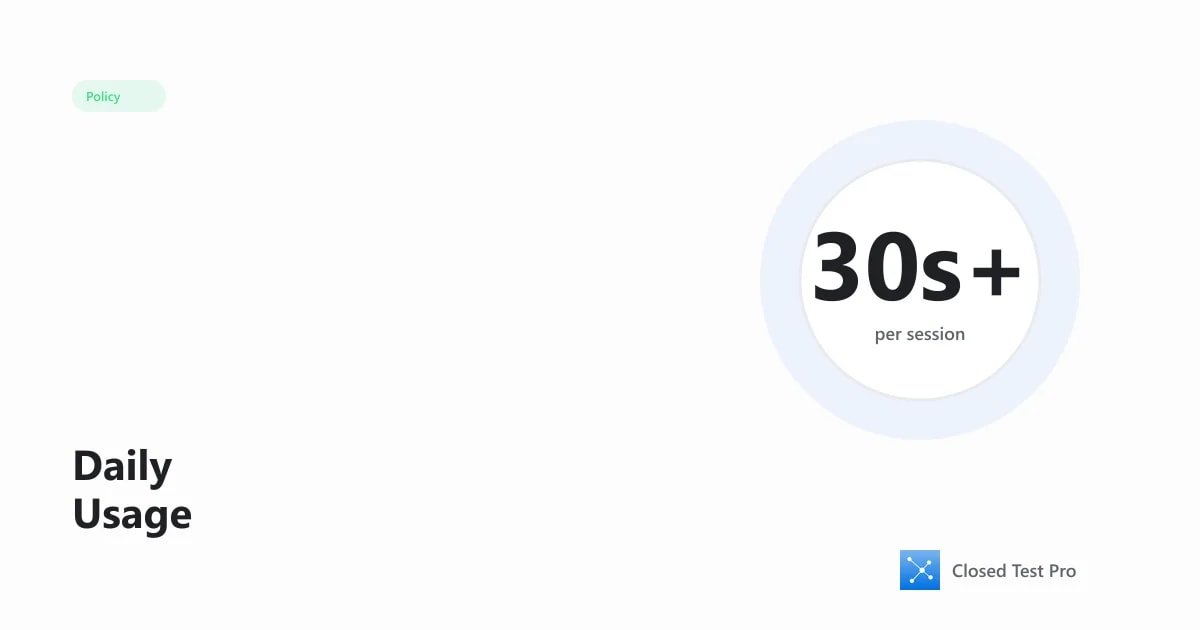
How Long Should Each Daily Tester Session Be?
Session length for closed testing: meaningful short opens beat marathon time — consistency across 14 days matters more than minutes logged.
Must Testers Open Your App Every Day? Rule vs Best Practice
Google’s written rule is continuous opt-in; near-daily opens are the safest engagement pattern. When a missed day becomes a problem.
If a Tester Misses One Day: Does Your 14-Day Window Reset?
What happens when closed testers skip a day: one miss is usually fine; opt-outs and mass gaps threaten continuity and engagement review.
How to Recover a Failed Closed Test Without Resetting Everything
How to recover a failed closed test: fix root causes, rebuild a continuous 12×14 window, and re-apply — without creating a new account.
How to Fix an Insufficient Testing Rejection Yourself
DIY recovery after Insufficient Testing Engagement: rebuild a continuous 12×14 window with real usage, then re-apply — no paid plan required.
How to Track Closed-Test Tester Activity Day by Day
How to track closed-testing activity: combine Play Console opt-in continuity with real open/session data — not spreadsheets alone.
How to Tell If a Tester Actually Opened Your App
How to verify closed testers opened your app: Play Console shows opt-in; analytics or Closed Test Pro confirm real opens.
How to Prevent Testers From Installing Once and Leaving
Stop install-and-leave closed testers with accountable recruiting, daily reminders, a stable first session, and fast replacements.
14-Day Tester Retention Tactics (Without Spamming)
Practical retention playbook for the full closed-test window: light reminders, clear expectations, and mutual accountability — not guilt DMs.
Daily Tester Reminders: Push vs DM vs Email
Compare reminder channels for closed testing. Why one automated daily push beats manual DMs and email for keeping opens alive.
How to Organize Closed Testing Without Google Sheets
Organize Google Play closed testing without spreadsheets: use Play Console for opt-ins plus a tracking platform for daily participation.
How to Monitor Daily Tester Drop-Offs
Monitor closed-testing drop-offs daily: watch opt-in count and opens, intervene at 1–2 silent days, replace before you fall under 12.
What to Do If Testers Uninstall Midway Through Testing
If closed testers uninstall: verify opt-in count, add replacements the same day, fix crash/UX causes, and protect the 14-day continuous window.
How to Pause and Resume Closed Testing Safely
There is no official Play Console “pause” for the 12×14 rule — fix fast or restart a clean continuous opt-in window before applying.
How to Validate Tester Participation Before Production
Validate closed testing before production: confirm continuous 12×14 opt-ins, real opens, low churn, then apply from the Play Console Dashboard.
Use Closed Testing to Fix Bugs — Not Only Hit 12 Testers
Quality-first angle: treat the 14-day window as bug-finding and UX validation time, not a headcount checkbox.
How to Collect Useful Feedback During Closed Testing
Practical ways to collect actionable bug reports and UX feedback during Google Play closed testing—without relying on vague “any feedback?” asks.
How Closed Testing Helps Catch Bugs Before Production
How to use Google Play closed testing to find crashes, UX bugs, and device issues before production—while meeting the 12-tester, 14-day rule.
What Kind of Feedback Google Likes to See
Google does not read private tester chats—but stability, retention, and engagement patterns from closed testing strongly affect production review outcomes.
Should You Push Updates During Closed Testing?
Yes—push closed-test updates for crash fixes and clear improvements. Avoid risky redesigns that break the 14-day engagement window.
How Many App Updates Are Ideal During Closed Testing
There is no magic update count for closed testing. Ship what fixes real issues—often a few targeted releases across 14 days—without risking engagement.
How to Use Closed Testing Data to Improve App Stability
Use Play Console vitals, crash clusters, and tester reports during closed testing to reduce crashes before you apply for production.
Why Family and Friends Testing Often Fails Google Review
Friends and family often opt in then disappear—killing the 14 consecutive days of real engagement Google Play expects from closed testing.
Real User Testing vs Friendly Testing: What's the Difference
Friendly testing relies on favors; real closed testing relies on accountable daily use—what Google Play evaluates for production access.
How Closed Testing Improves Your Production Launch
Treat closed testing as launch prep: fix crashes, validate UX, and prove 14 days of real engagement before you apply for Google Play production.
Why Mutual Testing Communities Are Effective
Mutual testing communities work because reciprocity, accountability, and shared Play Console know-how sustain 14 days of real engagement.
How Credit-Based Tester Systems Help Indie Developers
Credit-based tester systems let indie developers earn testing by helping others—fair access to 12 engaged testers for 14 consecutive days without paying cash first.
Is Tester Exchange Allowed by Google Play?
Yes—developers may test each other’s apps if usage is real. Fake testers, bots, and review/rating manipulation are not allowed.
How Community-Based Testing Reduces Rejections
Community closed testing reduces rejections by supplying enough opted-in testers, sustaining daily opens, and catching drop-offs before the 14-day window fails.
How Indie Developers Can Help Each Other Pass Closed Testing
Indie developers can pass closed testing faster by mutually testing apps—sharing the load of 12 engaged testers for 14 consecutive days.
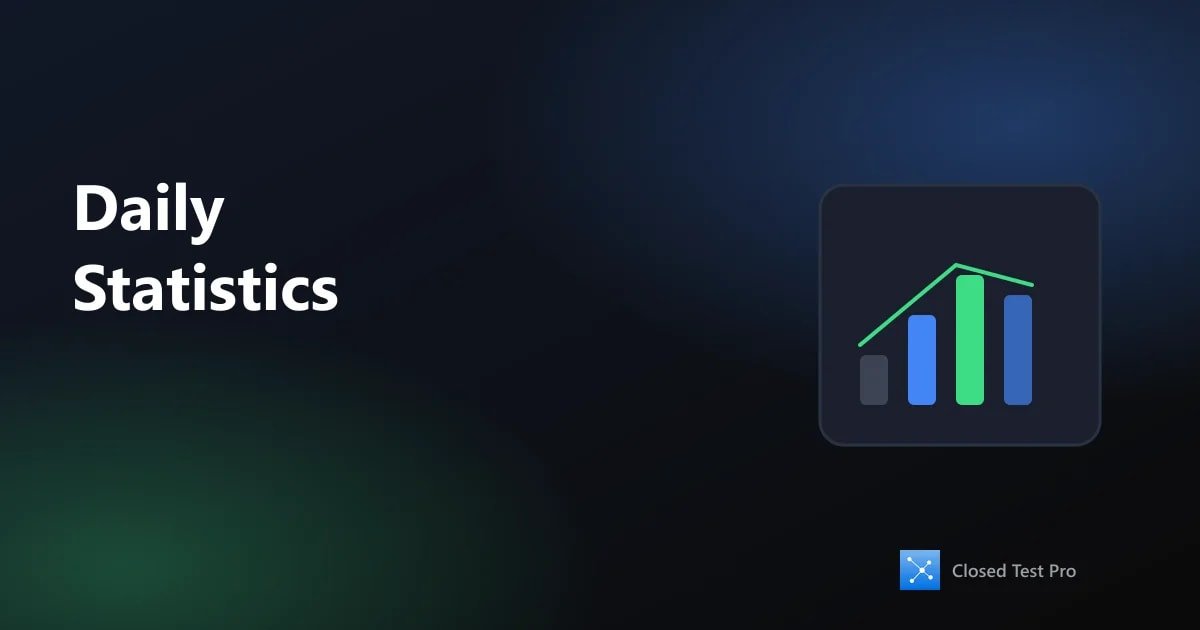
What Daily Tester Statistics Look Like in a Successful Closed Test
Healthy closed-test stats show ~12 opted-in testers opening the app across 14 consecutive days with low uninstalls—not a day-1 spike and silence.
How to Read Closed Testing Progress Correctly
Read closed-test progress by combining opted-in count, daily opens, trend direction, and consecutive-day continuity—not a single snapshot.
What a Healthy 14-Day Testing Timeline Looks Like
A healthy 14-day closed test keeps ~12 opted-in testers opening the app continuously from setup through finish—with quick fixes for early drop-offs.
How to Read Closed-Test Opens, Retention & Trends
Dashboard literacy for closed testing: interpret opens, retention, and day-to-day trends — then act when the ≥12 cohort is at risk.
Why Consecutive Daily Opens Beat One Busy Day
Why unbroken day-to-day opens matter for Google Play’s continuous 14-day closed testing window — and why a single spike is not enough.
How Uninstall Signals Affect Closed Testing
How tester uninstalls affect closed testing engagement signals and your path to production access.
How Google Interprets Tester Retention
How retention and engagement during closed testing relate to Google Play’s production-access review.
What a "Passing" Closed Testing Pattern Looks Like
What a healthy closed testing pattern looks like for personal accounts needing 12 testers over 14 consecutive days.
Daily Testing Pattern vs Random Opens: Which Passes Review?
Side-by-side: consistent daily opens vs sporadic bursts — which pattern better supports a continuous 14-day closed test.
Closed Testing Metrics Every Indie Developer Should Track
Essential metrics to monitor during Google Play’s 14-day closed testing period for personal developer accounts.
My Closed Test Is Stuck at 11 Testers — What to Do
What to do when your closed test is stuck at 11 opted-in testers and you need 12 for production access.
Closed Testing Running But Stats Not Showing — Explained
Why closed testing stats can lag or look empty—and how to verify real tester activity.
Testers Say Item Not Found — How to Fix It
How to fix “Item not found” when closed testers try to open or install your app on Google Play.
Why My App Isn't Appearing to Testers
Why testers cannot see your closed testing app in Google Play and how to fix it.
How to Fix Google Group Issues in Closed Testing
Fix Google Groups membership and sync problems that block closed testing opt-in on Google Play.
Why Some Testers Can't Install Your App
Diagnose why some closed testers can install your app while others cannot.
What to Do If Tester Count Drops Suddenly
What to do when your closed testing opted-in or active tester count drops unexpectedly.
How to Continue Closed Testing After an Error
How to recover and keep a closed test moving after crashes, drop-offs, or configuration mistakes.
How to Debug Closed Testing Issues Step by Step
A practical debugging checklist for Google Play closed testing install, opt-in, and engagement problems.
Common Closed Testing Setup Mistakes
Frequent Google Play closed testing setup mistakes that break the 12-tester, 14-day requirement—and how to avoid them.
Google Play Closed Testing: Beginner Setup Guide (2026)
First-time setup: create a closed track, invite testers, and complete 12×14 continuous days — a how-to start, not a “why Google requires it” essay.
Closed Testing vs Open Testing: What Is the Difference
Differences between Google Play closed testing and open testing—and which one new personal accounts must complete first.
From Upload to Production: Android App Release Explained
How Android apps move from Play Console upload through closed testing to production access.
How Google Evaluates New Developer Accounts
What Google looks for when reviewing new developer accounts.
Why Google Requires Closed Testing for New Developer Accounts
Policy background: the user-protection and quality reasons Google added the closed-testing gate for new personal Play Console accounts.
The Evolution of Google Play Testing Requirements
How Google Play closed testing evolved — from open publishing to the current 12 opted-in testers for 14 consecutive days on new personal accounts.
How Google Protects Users Through Closed Testing
Understanding Google's user protection strategy and the role of testing.
Best Practices for Safe App Launches
Launching your app successfully and safely on Google Play.
How Indie Developers Can Launch Faster
Strategies for accelerating your path to production without cutting corners.
Preparing Your App for Production Approval
Everything to check before applying for production release.
Pro & Premium Free Retesting: What “Guaranteed” Really Means
Honest breakdown of Closed Test Pro Pro/Premium: Tester Protection, 14 days free retesting, and what the production-access guarantee does — and does not — cover.
Premium Plan: 30 Testers to Reduce Insufficient-Testing Risk
Product guide: how Closed Test Pro Premium’s 30-tester buffer helps you stay above Google’s 12×14 bar after drop-offs — not a DIY recovery walkthrough.
Pro Plan ($9.99): Get 20 Real Testers for Closed Testing
Buy the Pro plan for 20 community testers, priority queue, and Tester Protection. Google’s minimum is 12×14; Pro’s 20 is a paid buffer.
Closed Test Pro Premium Explained: 30 Testers & Highest Priority
Full Premium ($21.99) plan tour: 30 testers, highest-priority queue, Tester Protection, and production-access terms — separate from the DIY rejection fix.
Free Web to APK: Convert Any Website to an Android App in Minutes
Learn how to convert any website into a native Android APK using Free Web to APK. Turn your website, blog, or web app into a downloadable Android application for free — no coding required.
Sign an Android AAB Online Free: jarsigner Without Android Studio
Sign an unsigned Android App Bundle for Google Play without installing a local JDK. Use Closed Test Pro AAB Signer with jarsigner, your keystore, and a secure GitHub Actions workflow.